For by Him were all things created, that are in heaven, and that are in earth, visible and invisible,...For the invisible things of Him from the creation of the world are clearly seen, being understood by the things that are made, ...so that THEY ARE WITHOUT EXCUSE: Col 1:16 / Rom.1:20
Showing posts with label Brain. Show all posts

Friday, May 8, 2026

Brain Complexity and Music

Thank you for making me so wonderfully complex!
Your workmanship is marvelous—how well I know it.
Psalm 139:14 NLT


"Studies show that our brains release dopamine while listening to music. This dopamine rush is the strongest when a song reaches its emotional climax and the listener feels the “chills— the spine-tingling, hair-raising sensation of awe.

The really interesting bit is the third set of neurons: these neurons only light up when we’re listening to music (and not speech) and try to predict what notes will come next, based on what notes you heard before.

We found acoustic information, like pitch or the changes between pitches in a melody. But we also found information that was encoded that reflects the listener’s prior experience with music. This is learned information.
It’s not bottom-up, it requires some internal model. Specifically, we found that listeners could predict the next note given the prior notes in the melody, and that information was encoded in a in a population of neurons in this auditory region,” Narayan Sankaran, a postdoc in the Chang Lab at UCSF and lead author of the study, told ZME Science."
ZME

Saturday, November 8, 2025

Male & Female

But from the beginning of the creation 
God made them male and female
Mark 10:6

Saturday, May 17, 2025

Designed Purpose of Your "eureka moments"

I will praise Thee; for I am fearfully and wonderfully made: marvellous are Thy works; and that my soul knoweth right well.
Psalm 139:14

"We've all experienced that "aha! moment," that sudden clarity or magical epiphany you feel when a new idea or perspective pops into your head as if out of nowhere.
Now, new evidence from brain imaging research shows that these flashes of insight aren't just satisfying—
--they actually reshape how your brain represents information
--and help sear it into memory.

Led by researchers at Duke University and Humboldt and Hamburg Universities in Germany, the work has implications for education, suggesting that fostering "eureka moments" could help make learning last beyond the classroom.

Such hidden picture puzzles serve as small-scale proxies for bigger eureka moments. "It's just a little discovery that you are making, but it produces the same type of characteristics that exist in more important insight events," said senior author Roberto Cabeza.
Participants tended to recall solutions that came to them in a flash of insight far better than ones they arrived at without this sense of epiphany.

"If you have an 'aha! moment' while learning something, it almost doubles your memory," said Cabeza, who has been studying memory for 30 years.

They discovered that flashes of insight trigger a burst of activity in
the brain's hippocampus, a cashew-shaped structure buried deep in the temporal lobe that plays a major role in learning and memory. The more powerful the insight, the greater the boost.


They also found that the activation patterns across the participants' neurons changed once they spotted the hidden object and saw the image in a new light—particularly in certain parts of the brain's ventral occipito-temporal cortex, the region responsible for recognizing visual patterns. The stronger the epiphany, the greater the change in those areas." 
MedicalXpress

Your Brain: Designed to Read

I will praise Thee; 
for I am fearfully and wonderfully made.... 
Psalm 139:14

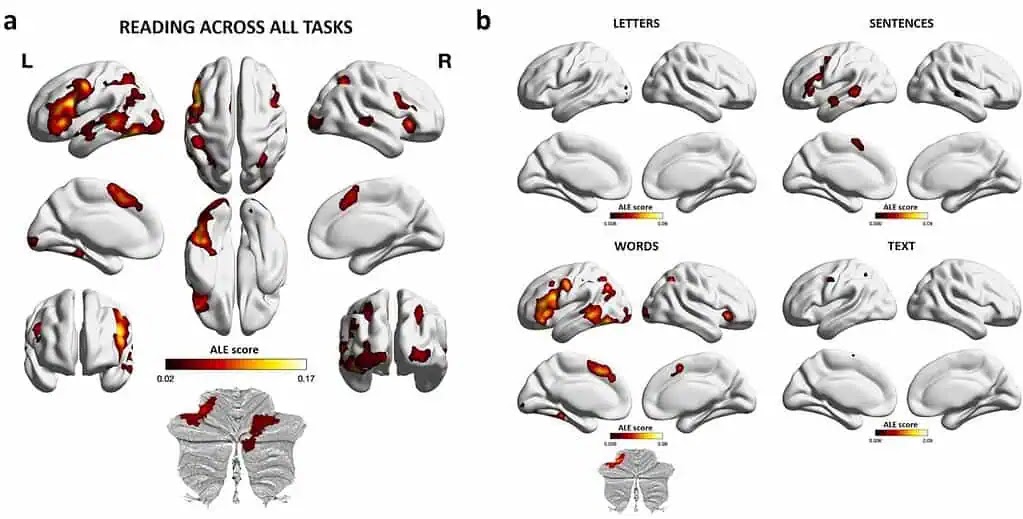
"It happens in a blink. Your eyes glance over a page, and letters become words. Words transform into meaning. Sentences unfurl into stories or arguments. 
A new review by neuroscientists at the Max Planck Institute for
Human Cognitive and Brain Sciences has revealed a clearer picture than ever before. “We found high processing specificity for letter, word, sentence, and text reading exclusively in left-hemispheric areas,” wrote Sabrina Turker and Beatrice Fumagalli.
Q: But what exactly happens in your brain when you read?

It shows how different types of reading — silently or aloud, genuine words or gibberish, judgments or comprehension — each have their own neural signature.

The findings confirmed that reading taps into the brain’s classical
language network — regions like the left inferior frontal gyrus (IFG), ventral occipito-temporal cortex (vOTC), and temporo-parietal cortex (TPC). 
But each level of reading brought unique activity: 
Letter reading activated just a narrow zone in the left occipital cortex, a region tied to visual processing.
Word reading engaged wider networks, including parts of the frontal and parietal lobes.
Sentence reading added further recruitment from areas involved in syntax and meaning-making, especially the middle and superior temporal gyri.
Text reading required coordination hubs like the precentral gyrus and supplementary motor area — likely reflecting how we hold complex information in working memory.
That progression is striking: the brain doesn’t just scale up the same processes. It reconfigures its activity based on the demands of the task.

One of the study’s most intriguing findings lies in how different reading styles trigger different brain activity. Overt reading  reading out loud — lit up auditory and motor regions, including the left insula and superior temporal cortex. These regions help us process sound and coordinate speech.

But when people read silently (covert reading), another system
kicked in: the multiple-demand network, including the frontal pole and paracingulate cortex. This system is associated with executive functions like attention and inhibition. “
More consistent reliance on multiple demand regions” during silent reading likely reflects the mental juggling act of forming internal speech while suppressing vocalization.

In other words, silently reading a sentence is less passive than it seems. It’s a high-order mental performance — speech without sound.

To further tease apart how the brain processes meaning, the team contrasted how we read real words versus pseudowords — strings like “sproke” or “glem.”

Real words triggered greater activity in regions associated with memory and meaning, like the angular gyrus, the middle temporal gyrus, and the orbitofrontal cortex. These areas help us retrieve known concepts and integrate them into what we’re reading.
Pseudowords, on the other hand, activated areas linked to phonological decoding — sounding out unfamiliar combinations. The precentral gyrus, pars opercularis of the IFG, and even right-hemisphere regions like the superior lateral occipital cortex all showed stronger engagement.

What emerges from this sweeping study is not a single “reading center” in the brain, but a flexible system that shifts depending on the demands of the text and the nature of the task.
ZME Science

Friday, March 14, 2025

Within 300 milliseconds

 Thank You for making me so wonderfully complex!
 Psalm 139:14 NLT

".....identified a brain signature of visual memorability that emerges around 300 milliseconds after seeing an image, involving areas across recognition
--the ventral occipital cortex 
--and temporal cortex
which processes information like color perception and object recognition.
This signature indicates that highly memorable images prompt stronger and more sustained brain responses, especially in regions like the early visual cortex, which we previously underestimated in memory processing.
While highly memorable images maintain a higher and more sustained response for about half a second, the response to less memorable images quickly diminishes."
MedicalXpress

Saturday, March 8, 2025

Brain's Superpower Nimbleness

 I will praise Thee; for I am fearfully and wonderfully made: 
Psalm 139:14

"Although working memory has very limited capacity—at any given
time, it can accommodate just four to seven pieces of information—it is essential for normal human functioning and represents what Spitzer calls a "
superpower."
The team believes the importance of working memory lies in its nimbleness—its ability to transform and reformat information." 
MedicalXpress

Saturday, January 11, 2025

ChatGPT still can't compete with human brain

 Thank you for making me so wonderfully complex!
Psalm 139:14 NLT

"The public release of ChatGPT on November 30, 2022, astonished the world. 

The spell was hard to resist. Bill Gates said that 
ChatGPT was “every bit as important as the PC, as the internet.”

Wharton professor Ethan Mollick predicted that the productivity gains might be larger than the gains from steam power.
In a seeming competition for the most exaggerated claims, Sundar Pichai, CEO of Alphabet and Google, proclaimed that, it is “more profound than fire” and Turing winner Geoffrey Hinton declared, “I think it’s comparable in scale with the Industrial Revolution or electricity — or maybe the wheel.”
Marc Andreessen spoke for many when he described it as, “Pure, absolute, indescribable magic.

ChatGPT and its competitors, in all their iterations, 
--are still just text-generators based on statistical patterns in the text databases they train on. 
--They do not know how words relate to the real world. 
They are consequently unable to do many of the things human brains can do 
--including assessing the validity of the text they input and output, 
--engaging in critical thinking
--and applying common sense

Human trainers may clean up some of the obvious mistakes made by large language models (LLMs) but such cleansing does not give LLMs human powers of reasoning and understanding.el.

There will continue to be modest improvements in their responses (assisted by human trainers), but the identification of statistical patterns in text they do not understand is not going to give us AGI, let alone superintelligence." 
MindMatters

Tuesday, December 31, 2024

Between Our Ears

I will praise Thee; for I am fearfully and wonderfully made:
Psalm 139:14

"The human brain is an engineering marvel that evokes comments from researchers like “beyond anything they’d imagined, almost to the point of being beyond belief”.
Q: Why do discoveries about the brain evoke such startling
statements from secular scientists? 
---The main reason is that random, purposeless evolution and its imaginary processes are entirely unable to account for the brain’s seemingly infinite complexity.

The scientists found that at multiple hierarchical levels in the whole brain, nerve cell clusters (ganglion), and even at the individual cell level, the positioning of neural units achieved a goal that human engineers strive for but find difficult to achieve—the perfect minimizing of connection costs among all the system’s components.

Researchers discovered that a single synapse is like a computer’s microprocessor containing both 
--memory-storage and 
--information-processing features. 

The previous oversimplified belief was that synapses acted like basic on/off switches—but nothing could be further from the truth since the brain acts more like a quantum computer than a digital computer. Just one synapse alone can contain about 1,000 molecular-scale microprocessor units acting in a quantum computing environment. An average healthy human brain contains some 200 billion nerve cells connected to one another through hundreds of trillions of synapses

Scientists discovered that the branched projections of neurons
(
dendrites) are not merely passive conduits but are electrically active in animal brains and generate nearly 10 times more electrical spikes than the main body of the neuron cell (called a soma).
These new results overturned the long-held belief that electrical spikes in the soma are the primary way in which the mental processes of perception, learning, and memory formation occur. While the somas produce all-or-nothing spikes of electricity like a digital signal, the
dendrites are hybrid systems performing both analog and digital transactions. 
Once again, this is more evidence of quantum computer-like brain engineering operating at warp speed levels. The large number of dendritic spikes also means the brain has more than 100 times the computational capabilities than was previously believed. 
While humans are only beginning to develop quantum computing devices, the Creator engineered our brains at a much more complicated, compact, and efficient level at the beginning of creation.

Yet another recent discovery revealed incredible levels of memory storage in the human brain. Dr. Sejnowski perhaps also unwittingly framed the results using designed-based thinking when he explained:
"We discovered the key to unlocking the design principle for how hippocampal neurons function with low energy but high computation power. Our new measurements of the brain’s memory capacity increase conservative estimates by a factor of 10 to at least a petabyte, in the same ballpark as the World Wide Web."
What a mighty Creator we have who can engineer
 that much memory between our ears
Nothing engineered by humans even comes close." 
ICR

Sunday, December 22, 2024

What the Brain Can't Do Tells Us.....

And the LORD God formed man of the dust of the ground, and breathed into his nostrils the breath of life; and man became a living soul. Genesis 2:7

"Penfield could find no part of the brain that, when stimulated, caused patients to think abstractly—to reason, think logically, do mathematics or philosophy or exercise free will.
He noticed the same thing about epileptic seizures as about stimulation during surgery. Patients who were having seizures did all sorts of things—they jerked their muscles, they saw flashes of light or had unusual sensations on their skin. They even occasionally had specific memories and emotions. Then they fell unconscious.
But patients never had intellectual seizures. That is, they never had seizures that caused them to reason, think logically, or do mathematics or philosophy.

Penfield asked the obvious question: why did brain stimulation only cause certain mental operations, like movement, perception, memory and emotion to happen, but not other ones, like abstract thought and free will?

Penfield started out as a materialist, like most scientists do, but, as he learned more about the mind and the brain he became a dualist. He concluded in his book Mystery of the Mind (1975) that the mind is something separate from the brain, and that there are aspects of the mind that don’t come from the brain but are spiritual in nature. As he put it, “The mind must be viewed as a basic element in itself . . .” (p. xxi.)
Neuroscience shows us that the brain is an organ, like the heart or the liver, that has specific jobs to do. The brain orchestrates our bodily processes (sometimes called vegetative functions)—our heart rate, our blood pressure, our hormone levels and so on. The brain is the source of our ability to move, to perceive, to remember and to have emotions.


But the brain is not the source of our intellect or our free will.

We are created by God with some abilities that are physical and some abilities that are not strictly physical—i.e., that are spiritual, created in His Image."

Michael Egnor

Saturday, December 14, 2024

Hierarchical Organization for Music

 I will praise Thee; for I am fearfully and wonderfully made: 
Psalm 139:14

The Brain---Made for Music.....
"Ever heard a snippet of a song and instantly known what comesnext? 
Or picked up the rhythm of a chorus after just a few notes? 
New research from the Center for Music in the Brain at Aarhus University has found that our brains process music through a specific hierarchical activation of several regions.

Bonetti and his colleagues found that when participants recognized the original memorized sequences, their brain activity followed a specific hierarchical pattern
This pattern began 
---in the auditory cortex, the region responsible for processing basic sound information, 
---and progressed to the hippocampus and cingulate gyrus, areas associated with memory and cognitive evaluation.

When variations were introduced into the sequences, the brain generated prediction errors
These errors started in the auditory cortex and then spread to the hippocampus, anterior cingulate gyrus, and ventromedial prefrontal cortex. 
Notably, the anterior cingulate gyrus and ventromedial prefrontal cortex exhibited their strongest responses when the variations were introduced.

The study also uncovered a consistent
 brain hierarchy characterized
by feedforward and feedback connections. Feedforward connections from the auditory cortices to the hippocampus and cingulate gyrus, along with simultaneous feedback connections in the opposite direction, were observed.

This 
hierarchical organization was consistent for both previously memorized and varied sequences, although the strength and timing of the brain responses varied. This suggests that while the overall structure of brain processing remains stable, the dynamics change depending on whether the sequence is familiar or novel.

Our study shows that the brain processes music by activating several brain regions in a specific, hierarchical order,” 
Bonetti told PsyPost. “Initially, sensory regions like the auditory cortex handle basic sound features. Then, this information is passed to a larger network of regions that arguably analyze the sounds more deeply, including the relationships between them (such as musical intervals). This process helps the brain determine if the sequence of sounds is familiar or new.”
PsyPost

Saturday, December 7, 2024

Your Spatio-Temporal Brain Dynamics

 Thank You for making me so wonderfully complex!
Psalm 139:14

"MIT Computer Science and Artificial Intelligence Laboratory (CSAIL) researchers have been seeking to uncover why certain images persist in people's minds, while many others fade. To do this, they set out to map the spatio-temporal brain dynamics involved in recognizing a visual image.

"We've identified a brain signature of visual memorability that
emerges around 300 milliseconds after seeing an image, 
---involving areas across the ventral occipital cortex and temporal cortex
---which processes information like color perception and object recognition
This signature indicates that highly memorable images prompt stronger and more sustained brain responses, especially in regions like the early visual cortex, which we previously underestimated in memory processing."

"These findings are exciting because they give us insight into what is happening in the brain between seeing something and saving it into memory," says Wilma Bainbridge. "The researchers here are picking up on a cortical signal that reflects what's important to remember, and what can be forgotten early on."
 
MedicalXpress

Friday, November 29, 2024

The Brains Dividing Line Between Order & Chaos

 Thank you for making me so wonderfully complex! 
Psalm 139:14

"By walking a tightrope between order and chaos, researchers could one day make computer chips work more like the human brain.
Researchers created conditions at the "edge of chaos,"
 a transition point between order and disorder that allows for rapid information transmission, in an electronic device.
It allowed the scientists to amplify a signal transmitted across a wire without using a separate amplifier — overcoming any signal loss due to electrical resistance.
But many researchers have theorized that the 
human brain operates on a similar principle.
---
Each neuron has an axon, a cable-like appendage that transmits electrical signals to nearby neurons. 
---Those electrical signals help your brain perceive your surroundings and control your body.
Axons
range from 0.04 inches (1 millimeter) to more than 3 feet (1 meter) in length. Transmitting an electrical signal across a wire of the same length leads to signal loss, caused by the resistance of the wire. Computer chip designers get around that issue by inserting amplifiers between shorter wires to boost the signal.
But axons don’t need separate amplifiers — they’re self-amplifying and can transmit electrical signals without much signal loss. Some researchers think that they exist at the edge of chaos, which allows them to amplify small fluctuations in electrical signals without letting those signals grow out of control." 
Live Science

Saturday, October 5, 2024

Triplicate Memory Storage

 I will praise Thee; for I am fearfully and wonderfully made: marvellous are Thy works; Psalm 139:14

"The 
memory of a specific experience is stored in multiple parallel “copies.” 
These copies are 
---kept for varying lengths of time
---modified to some extent, 
---and sometimes eventually deleted.

Professor Flavio Donato’s research group at the University’s Biozentrum found that memory development begins long before birth. 
At least three different groups of neurons in the brain’s hippocampus emerge at different stages during embryonic development. A single event is stored in parallel memory copies in all three — in triplicate, if you like.

First to arrive during development, the 
early-born neurons are responsible for the long-term persistence of a memory. In fact,
even though their 
memory copy is initially too weak for the brain to access, it becomes stronger and stronger as time passes. Also in humans, the brain might have access to such memory only some time after its encoding.
In contrast, the memory copy of the same event created by the 
late-born neurons is very strong at the beginning but fades over time, so that if one waits long enough, such a copy becomes inaccessible to the brain. 
In the middle ground, among neurons emerging in between the two extremes during development, a more stable copy could be observed.

The hippocampus is the seahorse-shaped inner part of the brain that plays an important role in 
memory and learning. There are actually two hippocampi, one on each side, but they are generally referred to as a single unit. People who have lost one or both have great difficulty forming or retaining memories.

The researchers think that the type of neuron in which a 
memory is stored there might relate to how easy it is for memories to change. The memories stored short-term via late-born neurons can, they say, be modified and rewritten: “This means that remembering a situation shortly after it has happened primes the late-born neurons to become active and integrate present information within the original memory.” 
But when an event is remembered after much time has passed, the memory retrieved from the  early-born neurons is hard to change.

Recalling an event soon after it occurs generally draws on those neurons that emerge late in development, which store the more malleable trace of the memory—which means that as we remember it, we can layer onto that memory trace associations with related events and ideas, and other new information. 
For example, you may learn to associate your first memory of a room with more recent experiences in that room, such as of a bad smell or painful accident. 
The different neuron populations allow us to preserve fundamental aspects of a memory over the long term, while also enabling us to adapt and incorporate new or related information we have learned about the world.
MindMatters

Saturday, August 31, 2024

Production of Speech

 I will praise Thee; 
for I am fearfully and wonderfully made:
marvellous are Thy works;
Psalm 139:14

"Humans are capable of generating extraordinarily diverse articulatory movement combinations to produce meaningful speech. 

--This ability to orchestrate specific phonetic sequences, 
--and their syllabification and inflection over subsecond timescales
--allows us to produce thousands of word sounds and is a core component of language.

Neuropixels recordings capable of sampling across the cortical column in humans, we discover neurons in the language-dominant prefrontal cortex that encoded detailed information about the phonetic arrangement and composition of planned words during the production of natural speech. 
These neurons represented the specific order and structure of articulatory events before utterance and reflected the segmentation of phonetic sequences into distinct syllables. 
They also accurately predicted the phonetic, syllabic and
morphological components of upcoming words and showed a temporally ordered dynamic. 
Collectively, we show how these mixtures of cells are broadly organized along the cortical column and how their activity patterns transition from articulation planning to production
We also demonstrate how these cells reliably track the detailed composition of consonant and vowel sounds during perception and how they distinguish processes specifically related to speaking from those related to listening
Together, these findings reveal a remarkably structured organization and encoding cascade of phonetic representations by prefrontal neurons in humans and demonstrate a cellular process that can support the production of speech." 
Nature

Saturday, August 17, 2024

Human Brains Unique from Animal Brains

 I will praise Thee; 
   for I am fearfully and wonderfully made:
      marvellous are Thy works;
Psalm 139:14

"Information doesn't make its way around our brains in the same way as it does in the brains of other animals, according to a new study.

Comparing the resulting brain 'traffic maps', the researchers found that the 
---human brain uses multiple parallel pathways to shift information from one region to another, 
---whereas the mice and macaque brains use just single channels.

"The basic principle is that messages passed from a source to a
target remain unchanged or are further degraded at each stop along the road, like the telephone game we played as children
."
To use another analogy, the information traffic moving around the brain is like traffic traveling down a road with multiple stops along the way. Our brains seem to be wired to simultaneously use multiple roads to get the convoy of signals to its destination.

What's more, the researchers discovered that these parallel pathways are as unique as fingerprints: studying the particular way that information flows around a brain can distinguish individual nervous systems.
"Such parallel processing in human brains has been hypothesized, but never observed before at a whole-brain level," says Griffa.

---If one channel gets blocked or damaged, then it's possible that information can be rerouted through another channel instead." 
ScienceAlert

Finely Detailed Cortical Organization of Semantic Representations

 I will praise Thee; for I am fearfully and wonderfully made:
marvellous are Thy works;
Psalm 139:14
"New techniques that can track brain activity down to a single neuron are now revealing exactly where this sound translation takes place within our minds.

"Humans possess an exceptional ability to extract nuanced meaning through language – when we listen to speech, we can comprehend the meanings of up to tens of thousands of words and do so seamlessly across remarkably diverse concepts and themes," says Harvard University neuroscientist Ziv Williams.

The recordings revealed words that share similar meanings like noodles and pizza create similar patterns of activity within participants' brains and that these patterns differ substantially when hearing words that have disparate meanings such as duck and coffee.

"We found that while 
--certain neurons preferentially activated when people heard words such as ran or jumped, which reflect actions, 
--other neurons preferentially activated when hearing words that have emotional connotations, such as happy or sad," explains Williams.

"
When looking at all of the neurons together, we could start building a detailed picture of how word meanings are represented in the brain."

What's more, the patterns of neuron activity in response to a word sound depends on what came before and after too.
"Rather than simply responding to words as fixed stored memory representations, these neurons seemed to adaptively represent word meanings in a context-dependent manner during natural speech processing," the team writes in their paper.
--This is what allows us to distinguish between homophones – words that sound the same but have different meanings like 'I' and 'eye'.

Together, these findings reveal a finely detailed cortical organization of semantic representations at the neuron scale in humans and begin to illuminate the cellular-level processing of meaning during language comprehension." 
ScienceAlert

Sunday, August 11, 2024

Your Thought Highway

I will praise Thee; for I am fearfully and wonderfully made:
marvellous are Thy works;
Psalm 139:14

"Have you ever wondered how your brain creates thoughts or why something randomly popped into your head? 
....actually the brain is like a supercomputer inside your head that helps you think, learn and make decisions.

The
neuron is a key player in the brain – these are tiny cells that send
and receive signals and messages so they can communicate with each other.
Your brain has somewhere between 80 billion and 100 billion neurons.
Neurons tend to group together to form neural tracts, which would be like the streets and highways in the city
When you have a thought, neurons in your brain fire up and create electrical impulses. These impulses tend to travel along similar pathways and release tiny chemicals called neurotransmitters along the way.

These neurotransmitters are like the construction crew that builds
the roads
.....You can imagine it as a dirt road, but as more traffic – that is,
neuron signals – travel the dirt road, the road gets upgraded to a paved street. If the traffic continues, it gets upgraded to a highway.

That’s why practice and repetition are important for improving your skills, whether playing the piano or learning a language. Neural networks are created and then strengthened the more times they communicate together. Scientists have a saying in this field: “Neurons that fire together wire together.”

The brain also stores memories, which are like files in a computer that you can access whenever you need them.
Creativity is another superpower of the brain. When you let your imagination run wild, your brain can come up with new ideas, stories and inventions.

The brain is a fascinating organ that works tirelessly to create thoughts, memories and ideas."
J.Robinson/Comversation

Brain-to-Brain Coupling

For then will I turn to the people a pure language, that they may all call upon the name of the LORD, to serve Him with one consent. Zephaniah 3:9

"When two people interact, their brain activity becomes synchronized, but it was unclear until now to what extent this
"brain-to-brain coupling" is due to linguistic information or other factors, such as body language or tone of voice.
Researchers report August 2 in the journal Neuron that brain-to-brain coupling during conversation can be modeled by considering the words used during that conversation, and the context in which they are used.
"We can see
---linguistic content emerge word-by-word in the speaker's brain before they actually articulate what they're trying to say,
---and the same linguistic content rapidly reemerges in the listener's brain after they hear it," says first author and neuroscientist Zaid Zada.....the researchers were able to observe brain activity associated with the context-specific meaning of words in the brains of both speaker and listener.
They showed that word-specific brain activity peaked in the speaker's brain around 250 ms before they spoke each word, and corresponding spikes in brain activity associated with the same words appeared in the listener's brain approximately 250 ms after they heard them. "This shows just how important context is, because it best explains the brain data," says Zada. "Large language models take all these different elements of linguistics like syntax and semantics and represent them in a single high-dimensional vector. We show that this type of unified model is able to outperform other hand-engineered models from linguistics."
MedicalXpress

Friday, May 24, 2024

DESIGNED Multitasking System

I will praise thee; for I am fearfully and wonderfully made: marvellous are thy works; and that my soul knoweth right well. Psalm 139:14

"Deep inside the brain the putamen, not just the cortex, contributes to multitasking ability.
Multitasking performance stems from the speed of information exchange between inner and outer regions of the brain.

--Doing two things at once courts disaster, as multitasking requires
outer cortical brain regions to rapidly communicate with each other. 
--The speed of this information exchange limits multitasking capability yet can improve with practice. 
--But that’s not the whole story: multitasking also depends on the striatum, a previously overlooked region deep inside the brain.

The putamen — a brain region in the striatum involved in habitual behavior — and two cortical regions were activated by the tasks separately and increased activity during multitasking.

After testing a variety of potential models, the research team found that multitasking ability hinged on how effectively the putamen could exchange information with the cortical areas.
*A week of practice improved the participant’s task performance in concert with an increase in communication rates between the putamen and the cortex."
SciTechDaily

Thursday, May 16, 2024

MEMORY

Remember the sabbath day, to keep it holy. For in six days the LORD made heaven and earth, the sea, and all that in them is, and rested the seventh day: wherefore the LORD blessed the sabbath day, and hallowed it. Exodus 20:8,11

"What is memory?
The general consensus is that memory is a multitude of cognitive systems which allow us to store information for certain periods of time so that we can learn from our past experiences and predict the future.
Whereas retrospective memory is about remembering what happened in the past, prospective memory is about reminding yourself to do something in the future.
Without prospective memory, you would not remember to go to work in the morning and you would forget to set your alarm clock in the evening.
One way to divide up retrospective memory is in the kinds of things it stores.

Implicit memory is essentially skill memory – the ability to do a task. If your implicit memory failed, you would not be able to brush your teeth, take a shower, drive your car or ride a bike. This kind of memory shows up in our abilities, but we can’t always articulate what it is we know in words and concepts.

Declarative memory, in contrast, is either memory for facts and meaning (semantic) or memory for events (episodic). Without semantic memory, you would not understand the content of what your colleagues or friends were saying. Without episodic memory, you would struggle to recount your day later to someone else.

Working memory (WM) manipulates and stores information for
short periods of time
. Talking with your colleagues, discussing a point at a meeting and planning your weekend would be entirely impossible without
WM. In contrast, long-term memory (LTM) serves as a long-term storage of information. Almost all of our everyday activities depend on LTM, such as remembering our way home or how to drive a car.

We need to break the act of remembering things into its atomic parts. Those parts are: 
Encoding—the process of putting the information into your brain.
Storage—the process of keeping the information in your brain.
Retrieval—the process of getting the information out of your brain when you need it.
Encoding is a process of imprinting information into the brain. Without proper encoding, there is nothing to store and attempting to retrieve the memory later will fail. 
One way to improve encoding is simply to repeat the information more times. Scientists who study memory call these repetitions “rehearsals” of the information.

For a memory trace to become permanently established in our long-term storage systems, structural biological changes must take place in brain tissue. New connections between neurons must be
formed
and firmly established.

In scientific terms, the mechanism through which recent memories become permanent memories is called ‘consolidation’. Although some consolidation occurs during wakefulness, the primary time for consolidation is sleep.

Retrieval is the mechanism of accessing information stored in memory. Successful retrieval of a memory trace hinges on its
associations with cues. A cue is anything that is connected to the
memory trace (physical object, situation, time period, word, question). 
Scientists believe that memories are retrieved through the process of ‘spreading activation’. 
Once a cue is activated in the brain, the activation spreads from the cue to the target memory. A single memory trace can be connected to an infinite number of cues.
ePocket